
Deeply Rooted

Project status
Innovation leads
Funding
Penn Medicine
Healthier Together Initiative, Children’s Hospital of Philadelphia
Sixers Youth Foundation
William Penn Foundation
External partners
Pennsylvania Horticultural Society
City of Philadelphia Department of Commerce
City of Philadelphia Parks & Recreation
Office of Clean and Green Initiatives – Councilmember Jamie R. Gauthier | 3rd District
PHL Taking Care of Business
Philadelphia Housing Authority
School District of Philadelphia
Opportunity
In Philadelphia, health inequities are deeply connected to place. Decades of systemic disinvestment have left many Black and Brown neighborhoods with fewer trees, more vacant land, higher exposure to violence, and chronic stressors that contribute to poorer health and safety outcomes. “Greening” these areas, for example by planting trees, cleaning and adding greenery to vacant lots, and creating parks and gardens, is a scalable, evidence-based, community-focused health intervention.
Research by Eugenia South, MD, MS, faculty director of the Center for Health Justice, and others has established that environmental improvements like these can raise health and safety: They reduce exposure to heat and pollution, support physical activity and social connection, and help mitigate downstream risks such as cardiovascular disease, adverse mental health outcomes, and violence.
For health systems, this presents an opportunity to complement clinical care with upstream, place-based investments that can improve quality of life and advance health equity at a population level.
Intervention
Deeply Rooted is a community-academic collaborative that uses the healing power of nature to promote health equity, well-being, and environmental justice. Working across eight neighborhoods in West and Southwest Philadelphia, the collaborative centers shared power and community to lead, plan, and drive greening initiatives that reflect neighborhood priorities and visions for a healthier future.
Through neighborhood greening, Deeply Rooted expands the health system into the community.
Example initiatives of Deeply Rooted:
- The Community Green Grants program provides residents with microgrants for activities that care for and appreciate nature in target neighborhoods.
- Leadership in Nature (LeadIN) instills youths 14–18 with the experience, confidence, and leadership skills to champion the green changes they wish to see in their communities.
- Green Nodes Plan is developing a network of accessible, community-driven miniparks throughout West and Southwest Philadelphia.
Deeply Rooted is led by the Center for Health Justice in partnership with community development corporations (CDCs), faith-based organizations, schools, and grassroots greening organizations. Foundational institutional supporters are Penn Medicine and the Children’s Hospital of Philadelphia. The Pennsylvania Horticultural Society is our strategic greening intervention partner.
Impact
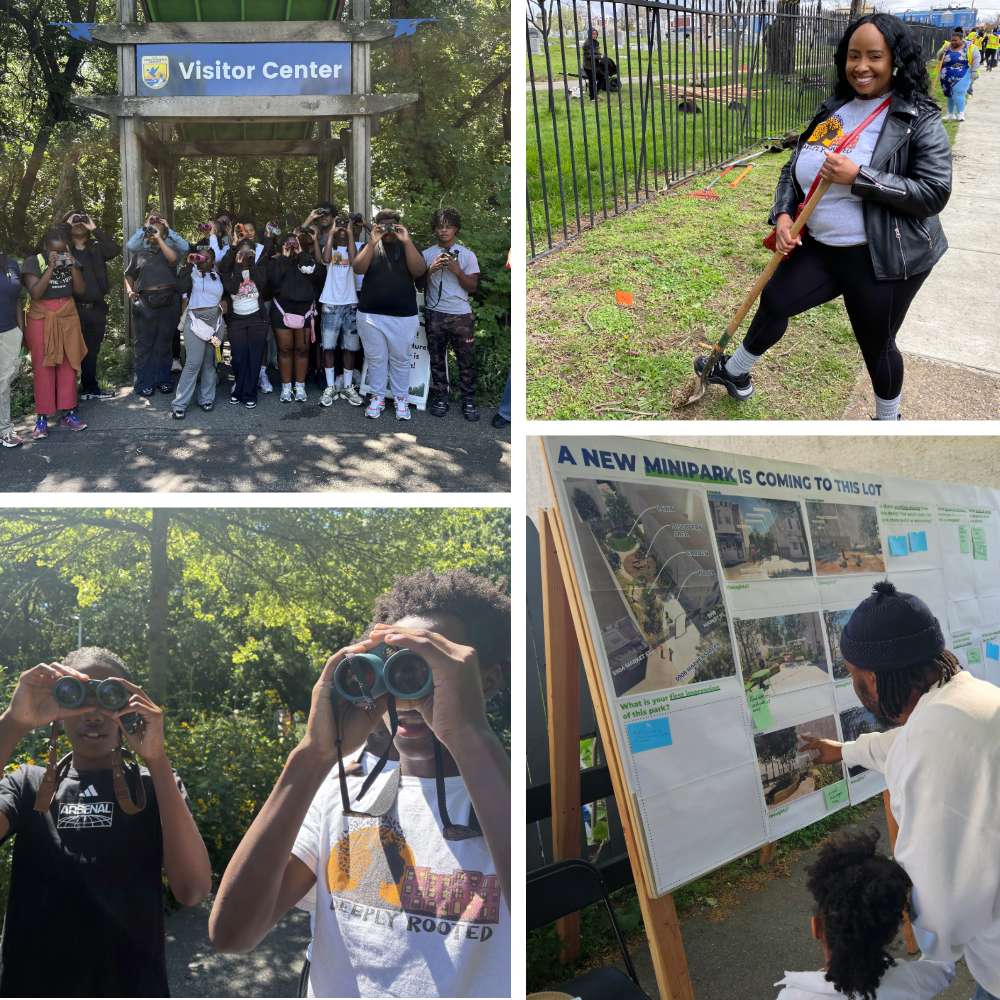 Launched in 2022 in four neighborhoods, Deeply Rooted expanded in 2023 to eight neighborhoods across West and Southwest Philadelphia: Kingsessing, Paschall, Elmwood, Cobbs Creek, Haddington, Mill Creek, Carroll Park, and Belmont. Together the Center for Health Justice and our partners improve and enhance the neighborhood green infrastructure and community capacity needed to sustain health-promoting environments.
As of April 2026, we have planted more than 1,000 trees and greened more than 1 million square feet of vacant lots. Through the Community Green Grants program, 99 people have received a collective $281,000 for a wide range of projects, from career workshops in agriculture and conservation to Black Girl Joy Bike Ride, a bicycling group for Black women. By the end of 2027, Deeply Rooted will have completed eight miniparks.
The inaugural LeadIN Summer Program launched in 2025 with a cohort of 17 youths. Over five weeks, participants engaged in hands-on, nature-based learning experiences, field trips, and a community-centered photovoice project that explored the connections between environment, health, and justice. Building on the success of the summer, the program continued throughout the 2025–26 academic year to further support youth leadership, exploration, and community engagement.
Innovation Methods

Quantitative data review

Quantitative data review

Quantitative data review
Gathering and analyzing quantitative data helps us understand what is happening in communities and establish benchmarks for measuring change. Our work builds on a growing body of evidence showing that improvements to neighborhood environments, such as greening vacant land and increasing access to nature, can reduce depression, improve safety and social cohesion, and strengthen overall community health outcomes.